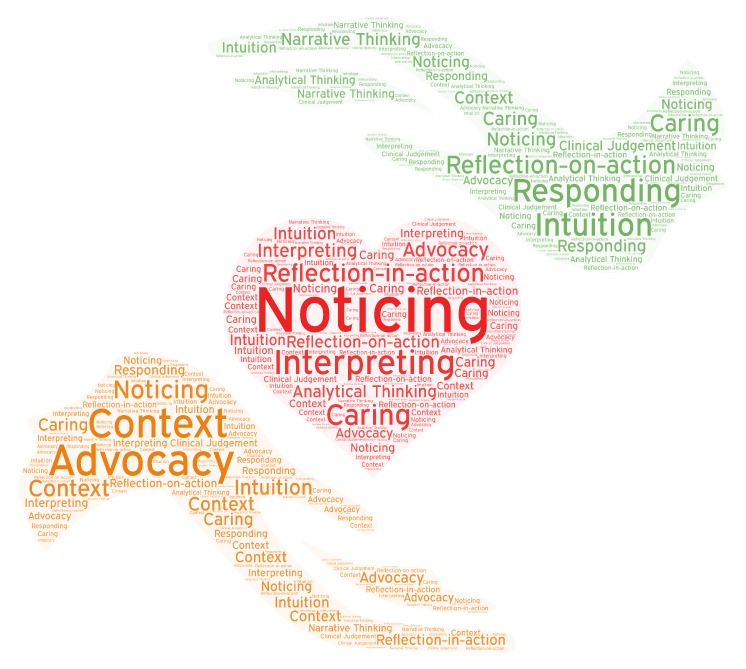
eHealth in Clinical Judgement

Created on: WordArt.com

Technology has become a big part of healthcare and whether we like it or not, it is here to stay. So how will it affect the way we do things? How will it impact our decisions for treatment and interventions, and where will it lead us to in terms of making clinical judgement? These are just some questions that result from the advancement of technology in health care, better known as eHealth.

Of course, there is validity to these questions as more and more rely heavily on technology for answers. Some may even rely on what they read off the internet, or what they view over an electronic health record (EHR) about a patient to make decisions, which in and of itself is a scary thought. When used in such a way, it seems to almost degrade humans of their capacity to think and use sound knowledge to make decisions. This is far from the truth. In order to avoid the notion of eHealth becoming the be all and end all of our clinical decisions when providing care, it should not be relied on solely but instead utilized as a tool to help and guide us make better judgements for better patient outcome. When used appropriately and when given the appropriate training, eHealth can be used to enhance communication between the multidisciplinary team, create widespread acceptance of eHealth resulting in consistency within documentation and information flow, and to better care and treatment for patients (De Raeve, Gomez, Hughes, et al., 2016).

After reflecting on a recent clinical situation that I have experienced, it was further validated that eHealth can assist in decision making in many ways as explained earlier. That is, when used appropriately and in conjunction with clinical judgement. While reviewing Tanner’s (2006) clinical judgment model, the use of eHealth to collect information, and how the information flowed was evident within the steps of the model. In this particular experience, the use of eHealth enabled the provision of information to validate clinical judgement regarding appropriate, and necessary interventions for end-of-life care for a client. Based on review of recent clinical documentation by the physician to provide comfort measures only, and in-depth review of the resident’s clinical diagnosis, it was obvious that the need to address pain symptoms was necessary. This was determined based on the steps of noticing. Knowing the client and piecing together information through reasoning using analytical, intuitive, and narrative thinking (Tanner, 2006), and putting this all together with information retrieved through data stored in the EHR allowed for the ability to respond to the clients’ needs.

Tanner (2006) talked about how nurses should think in terms of making clinical judgement, illustrating this within the clinical judgement model. We then discussed how eHealth intersects with this model, however, the benefits of eHealth can be so much more. eHealth can assist in guiding health professionals make appropriate decisions in areas such as pre-operative and post-operative procedures (Govindasamy, Manickkam, et al., 2013), health teaching of patients, and as described, palliative and end-of-life care just to name a few.

References:

De Raeve, P., Gomez, S., Hughes, P., Lyngholm, T., Sipila, M., Kilankska, D., Hussey, P., & Xyrichis, A. (2016). Enhancing the provision of health and social care in Europe through eHealth. International Nursing Review, 1-9. Retrieved from http://www.efnweb.be/wp-content/uploads/Enhancing-the-provision-of-health-and-social-care-in-Europe-through-eHealth-Final.pdf

Govindasamy, R., Manickam, P., Gopalakrishnan, G., & Muralidhara, S. (2013). Technology: An aid to clinical judgement. Annals of Cardiac Anaesthesia, 16(2), 137-139. Retrieved from file:///C:/Users/pcmey/Downloads/Technology_An_aid_to_clinical_judgement.pdf

Tanner, C.A. (2006). Thinking like a nurse: A research-based model of clinical judgment in nursing. Journal of Nursing Education, 45(6), 204-211. http://www.ncbi.nlm.nih.gov/pubmed/16780008

A review of the ‘Future Vision’ and ‘1960s EMR’ video: We have come a long way!

Future Vision & 1960s EMR: Would the idea be feasible in the future?

‘Future Vision’ Video
Microsoft Office 365, (2011)

After reviewing the video ‘Future Vision,’ a short video about what we can expect in the near future that was released in 2007, I do not believe that the question, “is this feasible?” applies any longer. It is the year 2019 and that future “vision” is practically already here. Regardless whether this video is a marketing strategy for Microsoft, it is not too far-fetched considering what we already have in place in our current world of eHealth. From being able to make appointments online, keeping track of schedules using a phone, to fitness tracking using a watch (ex: Apple watch), most of what we have seen in the ‘Future Vision’ video is already in place. It may not be to the extent where we can tap on our bedside table to track our medication usage, but we are more than one step closer to that reality. In 2013, an article by Wickramasinghe and Kirn (2013) on the Business & Information Systems Engineering Journal discusses eHealth and the future of health care information systems. Wickramansinghe and Kirn (2013) mentions that there is evidence that numerous vendors in the highly fragmented market for health care software offer their applications in app stores and on Android markets, which could have direct bearing on the architecture of present information systems used in medical practices and hospitals. Jump seven years ahead to our current now, this may even be considered old news. Applications or apps is just another word in everyone’s vernacular, and the variety of applications that is readily available is endless.

The near, if not actual reality of the ‘Future Vision’ video by Microsoft can be further proven by comparison of the 1960s EMR video.

1960s EMR Video
ACMI2008, 2008

In the 1960s EMR video, the thought of an input-output terminal to be utilized with the goal of decreasing the usage of paper may have seemed far-fetched in that era, probably much like the ‘Future Vision’ video when it was released. However, since the idea came about, we have come a long way,that we can say this video is both outdated in terms of time and innovation.

eHealth in Healthcare: Personal Experience and Point of View

In my 10 year experience working in long-term care, I have had the opportunity to experience change in informatics or eHealth, and become extensively involved with the use of its nursing technology aspect. This experience has led me to become familiar with some of the pros and cons of the use of information systems within the field. The specific system we use is PointClickCare (PCC), as well as the digital-pen, better referred to as the “digi-pen” used in the transcription process of physician’s orders. PCC is a cloud-based electronic health record (EHR) system (PointClickCare, 2019) which includes care delivery management, financial management, and quality and compliance management (Software Advice, 2019) systems, which our facility currently utilizes. Still, PCC offers a variety of options to incorporate with the day-to-day functioning of long-term care management, at a cost of course. In terms of nursing informatics, we utilize PCC for all clinical management such as reporting client health records, to tracking indicators for quality improvement initiatives. Being responsible for implementing the use of the Quality Indicator Assurance (QIA) tab within PCC to track our quality improvement initiatives, the user-friendliness and usefulness of the system is evident but with further use, gaps and ideas for improvement also becomes palpable. Nevertheless, PCC has not only significantly reduced the use of paper and offered many resources, it has definitely improved communication between the multidisciplinary team and other stakeholders, as well as clients and families.

References:

ACMI2008. (2008, Jan. 7). 1961 electronic medical records. Retrieved from https://www.youtube.com/watch?v=t-aiKlIc6uk

Microsoft Office 365. (2011, Oct. 24). Health future vision. Retrieved from https://www.youtube.com/watch?v=C4LbAUa4ZwY

PointClickCare. (2019). About Us. Retrieved from https://pointclickcare.com/about-pointclickcare-software/about-us/

Software Advice. (2019). PointClickCare – long-term care software. Retrieved from https://www.softwareadvice.com/long-term-care/pointclickcare-profile/

Wickramasinghe, N., & Kirn, S. (2013). E-health and the future of healthcare information systems. Business & Information Systems Engineering, 5(1), 1-2. Retrieved from https://link.springer.com/article/10.1007/s12599-012-0245-1

“Informatics” What is it really?

Nursing Informatics

Photo credit: https://www.google.com/url?sa=i&source=images&cd=&cad=rja&uact=8&ved=2ahUKEwjU_oG0mJfiAhUsneAKHaq9ACAQjRx6BAgBEAU&url=https%3A%2F%2Fwww.findlay.edu%2Fblog%2Finformatics-nurse&psig=AOvVaw3910INcN2dkSBazQimP0km&ust=1557791661639157

Initial thoughts on “informatics”…

In all honesty, when initially coming across the word “informatics” in the current course called Nursing Informatics, I simply associated this to the use of information in some way or another, with of course the focus being related to nursing. Specifically, the notion of informatics in nursing meant the use of technology to record, share, and analyze data in conjunction with providing care to patients. In 2019, the use of technology in healthcare has become more significant. It is even surprising to learn that some healthcare facilities still use paper documentation to maintain patient records. So, what exactly is nursing informatics?

What is Nursing Informatics?

After further research, informatics is much more than the use of information technology. Informatics is the study of the structure, behaviour, and interactions of natural and engineered computational systems (The University of Edinburgh, n.d.). Nursing informatics then, as defined by Staggers and Thompson (2002), is the use of technology such as computers to collect, store, process, display, retrieve, and communicate timely data and information in and across health care facilities that administer nursing services and resources, manage the delivery of patient and nursing care, link research resources and findings to nursing practice, and apply educational resources to nursing education (p.256). In simpler terms, nursing informatics is the science of taking information and technology and understanding how it integrates to support the practice of nursing in all its aspects (Stagger & Thompson, 2002). According to the Canadian Nurses Association (2019), the goal of nursing informatics is to improve the health of people and communities while reducing costs. Of course, there is no doubt that a handful of benefits comes with informatics in nursing, but with anything else, there is anticipated disadvantages that should also be considered which may be discussed in a later blog.

Thoughts on Nursing Informatics

In terms of the discipline of Nursing Informatics, this personally is also new to me. Although there is much more to learn about this discipline, the significance of its role in our current healthcare as well as in future is undeniable. As mentioned before, our healthcare system has become technologically advanced and it will only grow in complexity, alongside patient health and treatment, and other essential healthcare services. From personal experience with using technology in healthcare, the benefit of nursing informatics varies, but there remain gaps that need to be addressed to make use of the information effectively. Therefore, to put focus on the study of nursing informatics is vital in ensuring its effectiveness.

The following video briefly describes the profession of nursing informatics:

References:

Canadian Nurses Association. (2019). Nursing informatics. Retrieved from https://www.cna-aiic.ca/en/nursing-practice/the-practice-of-nursing/nursing-informatics

Staggers, N., & Thompson, C.B. (2002). The evolution of definitions for nursing informatics: A critical analysis and revised definition. Journal of the American Medical Informatics Association, 9(3), 255-261. Doi: 10.1197/jamia.M0946. Retrieved from https://www.ncbi.nlm.nih.gov/pmc/articles/PMC344585/

The University if Edinburgh. (n.d.). What is informatics? Retrieved from https://www.ed.ac.uk/files/atoms/files/what20is20informatics.pdf