Technology has become a big part of healthcare and whether we like it or not, it is here to stay. So how will it affect the way we do things? How will it impact our decisions for treatment and interventions, and where will it lead us to in terms of making clinical judgement? These are just some questions that result from the advancement of technology in health care, better known as eHealth.
Of course, there is validity to these questions as more and more rely heavily on technology for answers. Some may even rely on what they read off the internet, or what they view over an electronic health record (EHR) about a patient to make decisions, which in and of itself is a scary thought. When used in such a way, it seems to almost degrade humans of their capacity to think and use sound knowledge to make decisions. This is far from the truth. In order to avoid the notion of eHealth becoming the be all and end all of our clinical decisions when providing care, it should not be relied on solely but instead utilized as a tool to help and guide us make better judgements for better patient outcome. When used appropriately and when given the appropriate training, eHealth can be used to enhance communication between the multidisciplinary team, create widespread acceptance of eHealth resulting in consistency within documentation and information flow, and to better care and treatment for patients (De Raeve, Gomez, Hughes, et al., 2016).
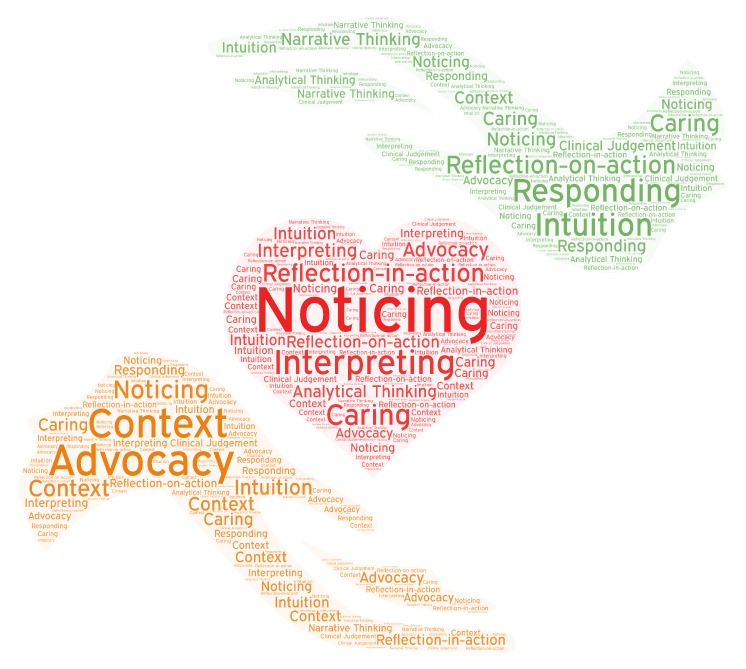
After reflecting on a recent clinical situation that I have experienced, it was further validated that eHealth can assist in decision making in many ways as explained earlier. That is, when used appropriately and in conjunction with clinical judgement. While reviewing Tanner’s (2006) clinical judgment model, the use of eHealth to collect information, and how the information flowed was evident within the steps of the model. In this particular experience, the use of eHealth enabled the provision of information to validate clinical judgement regarding appropriate, and necessary interventions for end-of-life care for a client. Based on review of recent clinical documentation by the physician to provide comfort measures only, and in-depth review of the resident’s clinical diagnosis, it was obvious that the need to address pain symptoms was necessary. This was determined based on the steps of noticing. Knowing the client and piecing together information through reasoning using analytical, intuitive, and narrative thinking (Tanner, 2006), and putting this all together with information retrieved through data stored in the EHR allowed for the ability to respond to the clients’ needs.
Tanner (2006) talked about how nurses should think in terms of making clinical judgement, illustrating this within the clinical judgement model. We then discussed how eHealth intersects with this model, however, the benefits of eHealth can be so much more. eHealth can assist in guiding health professionals make appropriate decisions in areas such as pre-operative and post-operative procedures (Govindasamy, Manickkam, et al., 2013), health teaching of patients, and as described, palliative and end-of-life care just to name a few.
References:
De Raeve, P., Gomez, S., Hughes, P., Lyngholm, T., Sipila, M., Kilankska, D., Hussey, P., & Xyrichis, A. (2016). Enhancing the provision of health and social care in Europe through eHealth. International Nursing Review, 1-9. Retrieved from http://www.efnweb.be/wp-content/uploads/Enhancing-the-provision-of-health-and-social-care-in-Europe-through-eHealth-Final.pdf
Govindasamy, R., Manickam, P., Gopalakrishnan, G., & Muralidhara, S. (2013). Technology: An aid to clinical judgement. Annals of Cardiac Anaesthesia, 16(2), 137-139. Retrieved from file:///C:/Users/pcmey/Downloads/Technology_An_aid_to_clinical_judgement.pdf
Tanner, C.A. (2006). Thinking like a nurse: A research-based model of clinical judgment in nursing. Journal of Nursing Education, 45(6), 204-211. http://www.ncbi.nlm.nih.gov/pubmed/16780008


 Nurse Paola's Blog